Haircuts for Growing Out Hair Mens: Complete Style Guide
Introduction
Growing your hair out sounds simple. You stop cutting it and wait for it to get longer. However, most men quickly discover that the process is not that easy. Hair grows at different rates across the scalp, creating uneven shapes, unwanted bulk, and awkward transition periods.
The biggest challenge is not growing hair. The real challenge is looking good while it grows. Many men quit during the awkward stage because their hair starts flaring around the ears, puffing out on the sides, or developing an unbalanced silhouette. Without the right strategy, the journey from short hair to long hair can feel frustrating.
Fortunately, the right haircuts for growing out hair mens styles can make every stage look intentional. By understanding growth patterns, weight distribution, and strategic trimming, you can maintain a polished appearance while moving toward your desired length. This guide explains every growth phase, the best transition haircuts, professional barber techniques, and proven maintenance strategies.
Why Growing Out Men’s Hair Requires a Different Haircut Strategy
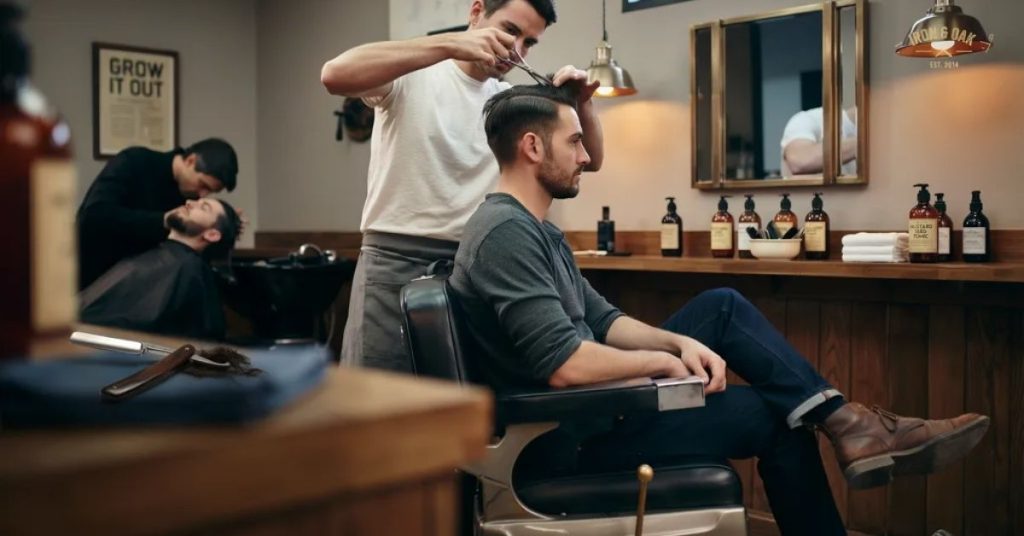
Most men assume that avoiding haircuts helps hair grow faster. In reality, strategic maintenance often creates better results.
Hair growth follows a biological cycle called the anagen phase. During this active growth period, hair typically grows about half an inch per month. However, because different areas of the scalp begin at different lengths, growth rarely appears uniform.
Several factors influence the process:
- Hair density
- Follicular health
- Sebum production
- Hair texture
- Existing haircut structure
- Split-end propagation
Instead of eliminating haircuts entirely, successful growth plans focus on preserving length while controlling shape.
Understanding the Awkward Stage of Hair Growth

What Is the Awkward Stage?
The awkward stage occurs when hair becomes too long for short hairstyles but too short for longer styles.
During this period, hair often:
- Sticks out behind the ears
- Creates side bulk
- Loses shape
- Appears uneven
- Feels difficult to style
This phase usually appears between months three and eight, depending on starting length and hair type.
Why Most Men Struggle During the Transition

The sides and back often create problems first. As these areas gain length, they push outward rather than falling naturally.
Men with:
- Thick hair
- Wavy hair
- Curly hair
- High-density growth patterns
typically experience the most noticeable awkward stages.
The Awkward Stage Proportional Growth Matrix
One of the most effective ways to understand growth progression is through a structural framework used by professional barbers.
| Growth Milestone | Timeframe | Head Region Ratios (Sides vs. Top) | Optimal Transition Haircut |
| Phase 1: The Perimeter Trap | Months 1–3 | 1:1 Ratio | Low Taper Fade |
| Phase 2: The Wing Effect | Months 4–6 | 1.5:1 Ratio | Point-Cut Textured Crop |
| Phase 3: The Mullet Zone | Months 7–9 | 2:1 Ratio | Nape Cleanup & Texturizing |
| Phase 4: Flow Baseline | Month 10+ | Unified Weight Distribution | Bro Flow / Tuck-Back Style |
This matrix helps explain why different hairstyles work at different growth stages.
Phase 1: The Perimeter Trap (Months 1–3)
Best Haircut: Low Taper Fade
The first growth phase often feels manageable. The challenge involves maintaining clean edges around the ears and neckline.
A taper fade for growing out hair provides structure without sacrificing future length.
Benefits
- Maintains a professional appearance
- Keeps ears clean
- Preserves top growth
- Creates shape during early stages
Barber Instructions
Ask your barber to:
- Clean the neckline
- Taper sideburns
- Leave crown untouched
- Preserve top length
This approach prevents unnecessary setbacks.
Phase 2: The Wing Effect (Months 4–6)
Why Hair Starts Flaring Out
This period causes the greatest frustration.
As hair gains length, the sides begin pushing outward. Instead of laying flat, the hair expands horizontally.
Many men mistakenly cut everything short during this stage.
However, professional barbers use a different approach.
The 30% Volume Relief Texturizing Technique
One proprietary method frequently used behind the chair is the 30% Volume Relief Technique.
Rather than removing visible length, the barber strategically reduces internal weight.
How It Works
- Texturizing shears enter the hair approximately 1.5 inches from the scalp.
- Interior channel cutting removes excess density.
- The outer perimeter remains untouched.
- Internal bulk decreases by approximately 25–30%.
Benefits
| Traditional Thinning | 30% Volume Relief Technique |
| Removes visible shape | Preserves shape |
| Can create uneven growth | Maintains uniform growth |
| May expose scalp | Retains fullness |
| Alters silhouette | Controls bulk naturally |
The result allows hair to sit closer to the head rather than expanding outward.
Best Low Maintenance Haircuts for Growing Out Hair
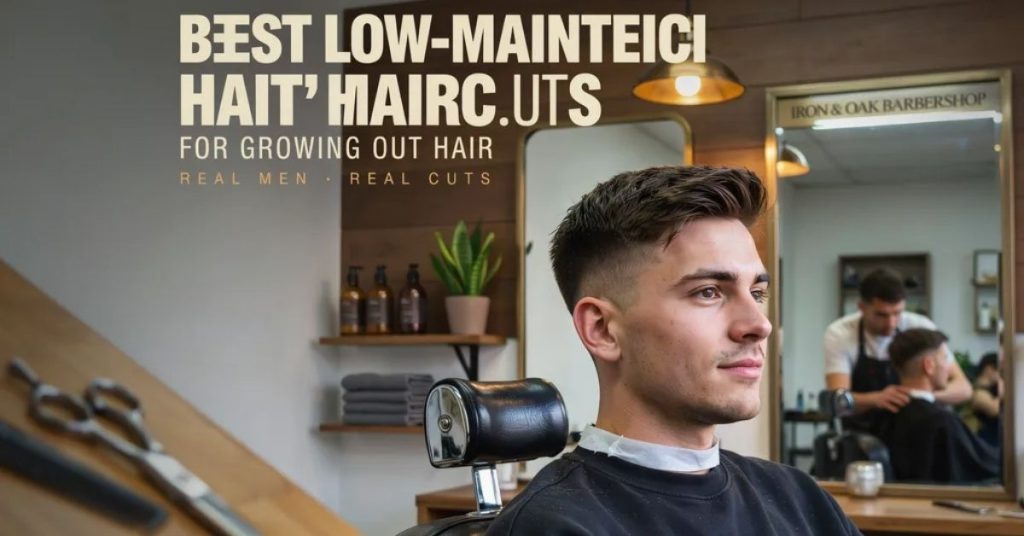
Several styles work exceptionally well during this stage.
Point-Cut Textured Crop
A textured crop maintains movement while reducing bulk.
Soft Taper
A soft taper keeps the perimeter clean without affecting overall length.
Layered Scissor Cut
Layering redistributes weight and improves shape.
Hidden Undercut
A hidden undercut for intermediate length hair removes excess density underneath while preserving the appearance of longer hair.
Phase 3: The Mullet Zone (Months 7–9)
Why the Back Starts Looking Longer
At this point, the nape often outgrows surrounding sections.
Many men believe they are accidentally developing a mullet.
In reality, the back simply reaches visible length first.
Nape Cleanup and Perimeter Line Refinement
Instead of cutting length from the entire head, barbers focus on perimeter refinement.
Key Adjustments
- Clean neck edges
- Remove split ends
- Refine perimeter lines
- Soften bulk at the nape
These minor changes dramatically improve overall shape.
Phase 4: Flow Baseline (10+ Months)
The Reward Stage
After ten months, most men finally achieve enough length for versatile styling.
At this point, weight distribution becomes more balanced.
Popular styles include:
- Bro Flow
- Tuck-Back Hair
- Medium Layers
- Curtain Hairstyles
- Long Textured Flow
Men’s Long Hairstyles Transition Phases
| Growth Length | Recommended Style |
| 1–3 Inches | Textured Crop |
| 3–5 Inches | Side Sweep |
| 5–7 Inches | Bro Flow |
| 7–10 Inches | Layered Flow |
| 10+ Inches | Long Men’s Hairstyles |
Each phase builds naturally toward the next.
How Often to Trim Hair When Growing It Out
One of the most common questions involves maintenance frequency.
Recommended Schedule
| Hair Growth Stage | Trim Frequency |
| Months 1–3 | Every 4–6 Weeks |
| Months 4–6 | Every 6–8 Weeks |
| Months 7–12 | Every 8–10 Weeks |
| Long Hair Maintenance | Every 10–12 Weeks |
Regular trimming helps prevent split-end propagation and maintains shape.
Thick Hair Men’s Haircut for Growing Out Length
Men with thick hair face unique challenges.
Excess density creates:
- Puffiness
- Bulk
- Side expansion
- Difficult styling
Best Solutions
Internal Texturizing
Removes excess density without reducing length.
Layering
Creates movement and better weight distribution.
Hidden Undercut
Reduces bulk beneath longer top sections.
Low Taper Fade
Maintains a clean outline while preserving growth.
How to Fix Awkward Stage Curly Hair Male Clients Experience
Curly hair grows differently than straight hair.
Shrinkage often hides actual progress.
Common Issues
- Triangle shape
- Excess side volume
- Uneven curls
- Frizz
Solutions
- Strategic layering
- Curl-specific trimming
- Moisture-focused products
- Bulk reduction techniques
Never aggressively thin curly hair. Instead, use controlled texturizing methods.
Should I Get a Low Taper Fade When Growing Out Hair?
The answer is usually yes.
A low taper fade remains one of the safest transition haircuts.
Advantages
- Preserves future length
- Maintains professionalism
- Keeps edges clean
- Works with most hair types
Avoid
- High fades
- Skin fades every visit
- Aggressive side removal
These cuts can delay long-term growth goals.
Barber Script: What to Say When Growing Out Hair
Many clients struggle to explain their goals clearly.
Use this exact barber script.
Copy-and-Paste Barber Script
“I am growing out my hair long-term. Today, please do not touch the length on the top or upper crown. I only need a low taper on the sideburns and nape, and please use interior point-cutting to collapse the bulk behind my ears so it doesn’t flare out.”
This script immediately communicates your objectives.
6-Month Barber Script Case Study
Client Background
A client started with a #2 buzz cut and wanted shoulder-length flow hair.
Initial Challenges
- Thick hair density
- Fast side growth
- Professional office environment
- Concern about looking unkempt
Month-by-Month Strategy
| Month | Adjustment |
| Month 1 | Low taper cleanup |
| Month 2 | Sideburn refinement |
| Month 3 | Neckline cleanup |
| Month 4 | 30% volume relief technique |
| Month 5 | Interior point-cutting |
| Month 6 | Layered shaping |
Outcome
The client maintained a polished appearance throughout the transition.
Most importantly, no major length was removed.
By month six, he had enough length for a controlled flow style without experiencing the typical awkward stage problems.
Essential Products for Growing Out Men’s Hair
Lightweight Styling Cream
Provides control without stiffness.
Sea Salt Spray
Adds texture and movement.
Leave-In Conditioner
Supports follicular health and moisture balance.
Hair Oil
Reduces frizz and protects ends.
Volumizing Mousse
Ideal for fine hair needing lift.
Mistakes to Avoid When Growing Out Hair
Cutting Too Much Too Soon
Many men panic during the awkward stage.
Avoid major changes.
Skipping Trims Entirely
Shape matters just as much as length.
Ignoring Split Ends
Split-end propagation can travel upward and damage healthy hair.
Choosing the Wrong Barber
Find a barber experienced with growth transitions.
Using Heavy Products
Excessively heavy products can make growing hair look greasy and flat.
Author Bio
Author: Hamza
Credentials: Licensed Master Barber & Menswear Stylist (10+ Years Experience)
Bio:
Hamza is a Master Barber and founder of Barber Model, specializing in hair texturing and long-term style transitions. Over a decade behind the chair, Hamza has personally guided more than 500 clients through the difficult “awkward stage” of hair growth. By combining precise scissor work with structural weight management, they help clients maintain a clean, professional aesthetic at 2 inches, 6 inches, and beyond. Their work has been featured in leading styling publications, and they actively consult on product formulation for men’s grooming brands.
Conclusion
Successfully growing long hair requires more than patience. It requires strategy. The best haircuts for growing out hair mens styles focus on managing weight distribution, controlling bulk, and preserving length at every stage. By understanding the awkward stage, following a structured transition plan, and using professional techniques like the 30% Volume Relief Texturizing Technique, you can maintain a polished appearance from month one through month ten and beyond.
Whether you choose a low taper fade, hidden undercut, textured crop, or bro flow, the key is making each stage look intentional. With the right barber, the right communication, and consistent maintenance, you can move from short hair to long hair confidently while avoiding the common pitfalls that cause most men to give up too early.
FAQs
How long does it take to grow men’s hair long?
Most men grow approximately six inches of hair per year. Achieving shoulder-length hair often takes 18–24 months.
How often should I trim hair when growing it out?
Most men benefit from trims every 6–8 weeks, depending on hair type and growth stage.
What is the best haircut for growing out hair mens styles?
A low taper fade combined with strategic texturizing remains one of the best transition haircuts.
Can I grow out thick hair without looking puffy?
Yes. Internal texturizing and proper weight distribution help reduce bulk while preserving length.
What should I tell my barber when growing out my hair?
Use a clear barber script explaining that you want to preserve top length while refining the perimeter and reducing internal bulk.