Mens Cowlick Haircuts: The Complete Barber’s Guide
Introduction
Cowlicks can make even the most expensive haircut look unbalanced. One day your hair sits perfectly, and the next day a stubborn section sticks straight up, parts in the wrong direction, or creates an unexpected gap at the crown. Many men struggle with cowlicks and often blame their barber, products, or hair type when the real issue lies in the natural growth pattern of their hair follicles.
The good news is that a cowlick is not a problem that needs to be eliminated. Instead, it is a natural hair growth characteristic that can be managed through proper haircut selection, strategic weight distribution, and effective styling techniques. Professional barbers work with cowlicks every day, and the most successful cuts are designed around the hair’s natural movement rather than against it.
In this comprehensive guide, you will learn everything about mens cowlick haircuts, including the science behind cowlicks, how to identify your specific cowlick type, the best haircuts for different growth patterns, styling techniques used by professional barbers, and real-world case studies that demonstrate effective solutions.
What Is a Cowlick?
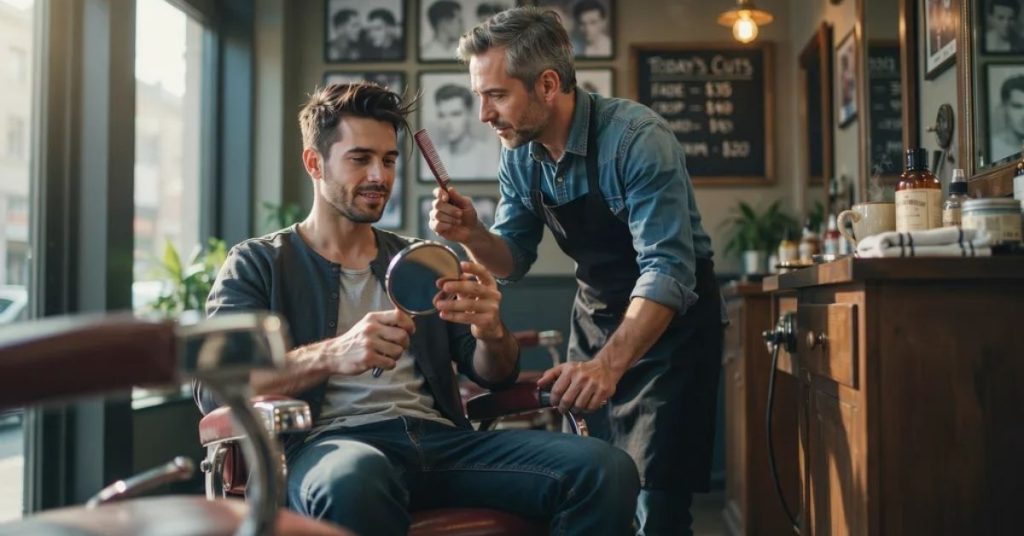
A cowlick occurs when a section of hair grows in a different direction from the rest of the hair. This occurs because of the angle and orientation of the hair follicle beneath the scalp.
Most hair follicles emerge at relatively consistent angles. However, a cowlick develops when a cluster of follicles grows at a significantly different angle or forms a circular growth pattern known as a hair whorl.
Common locations include:
| Cowlick Location | Typical Issue |
| Front Hairline | Hair sticks up or parts unexpectedly |
| Crown | Visible separation or exposed scalp |
| Side Temple | Uneven flow and styling difficulty |
| Nape Area | Hair grows upward or outward |
| Double Crown | Multiple swirling patterns causing instability |
Understanding the exact location of your cowlick is the first step toward choosing the right haircut.
The Anatomy of a Cowlick
Professional barbers evaluate more than just hair length when addressing stubborn growth patterns.
Several anatomical factors influence how a cowlick behaves:
Hair Whorl Pattern
The whorl is the circular pattern where hair grows around a central point.
Follicle Angle
Standard follicles typically emerge at approximately 45 degrees. Cowlick follicles often emerge at much flatter angles or spiral in multiple directions.
Growth Direction
Hair naturally grows in the direction determined by its follicle.
Hair Density
Thicker hair often creates more resistance, making cowlicks appear stronger.
Parietal Ridge
The widest area of the head significantly influences how weight distribution affects cowlick control.
Visual Element: Follicle Direction Diagram
Recommended Placement: Directly below this section.
Diagram Content:
- Standard 45-degree follicle angle
- Flat follicle angle under 15 degrees
- Circular crown whorl
- Double crown pattern
- Hair shaft growth comparison
This visual helps readers understand why some hairs naturally resist styling attempts.
The 360-Degree Growth Angle Assessment
Before choosing one of the many best haircuts for men with cowlicks, professional barbers perform a diagnostic assessment.
This proprietary framework helps identify the best solution for each individual.
The Clockface Method
Imagine the crown of your head as a clock.
Step 1: Locate the Center
Find the central point where the hair rotates.
Step 2: Map Growth Direction
Observe where the hair naturally moves.
Examples:
- 12 to 3 o’clock
- 3 to 6 o’clock
- 6 to 9 o’clock
- 9 to 12 o’clock
Step 3: Identify Resistance Zones
These are areas where the hair pushes against surrounding growth patterns.
Step 4: Assess Density
Determine whether the area has:
- Low density
- Medium density
- High density
Step 5: Measure Styling Resistance
Use your fingers to push the hair against its growth direction.
Rate resistance:
| Resistance Level | Description |
| Low | Easily redirected |
| Medium | Moderate resistance |
| High | Quickly returns to original position |
| Extreme | Nearly impossible to redirect |
Diagnostic Checklist for Men

Use this simple mirror check to determine the best haircut for your hair pattern.
Front Cowlick Assessment
- Does hair split naturally?
- Does the fringe stand up?
- Does one side grow faster?
Crown Cowlick Assessment
- Is scalp visibility increasing?
- Does the crown separate after styling?
- Does hair flatten during the day?
Density Assessment
- Fine Hair
- Medium Hair
- Thick Hair
The answers help determine the most suitable haircut structur
Why Does the Hair at My Crown Keep Sticking Up?
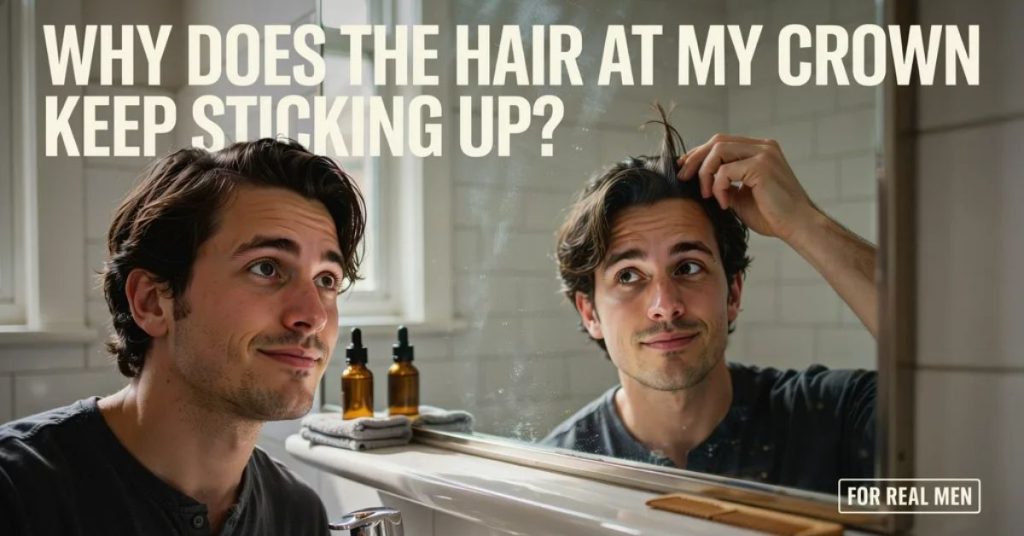
This is one of the most common concerns among men:
What causes my crown hair to stand up?
The answer usually involves a combination of:
- Strong crown whorl patterns
- High-density hair
- Short haircut length
- Incorrect weight distribution
- Improper styling direction
When hair is cut too short around the crown, there is not enough weight to counteract the natural growth pattern.
This often causes the hair to stand upright or separate.
Best Haircuts for Men With Cowlicks
The ideal haircut depends on the location and strength of the cowlick.
Textured Crop
The textured crop remains one of the most effective men’s cowlick haircuts.
Benefits
- Works with natural movement
- Creates visual texture
- Minimizes separation
- Easy daily maintenance
Best For
- Frontal cowlicks
- Moderate crown cowlicks
- Thick hair
French Crop
A French crop allows the fringe to disguise front growth irregularities.
Advantages
- Reduces visible lift
- Controls front cowlicks
- Low styling effort
Best For
- Mens haircuts for front cowlick
- Receding hairlines
- Straight hair
Crew Cut
The crew cut offers a practical option when cowlicks are mild.
Benefits
- Clean appearance
- Easy maintenance
- Professional look
Best For
- Mild cowlicks
- Athletic lifestyles
Textured Quiff
A textured quiff embraces movement rather than fighting it.
Advantages
- Creates intentional volume
- Works with directional growth
- Modern appearance
Best For
- Thick hair
- Front cowlicks
Short Mens Haircuts Cowlick Solutions
Men seeking shorter styles often benefit from:
| Haircut | Cowlick Control |
| Buzz Cut | Moderate |
| Crew Cut | Good |
| High Fade | Excellent |
| Textured Crop | Excellent |
| French Crop | Excellent |
Hairstyles for Crown Cowlick
The following styles help manage crown separation:
High Skin Fade
Removes conflicting weight around the swirl.
Textured Crop
Maintains enough length for control.
Layered Medium Length Style
Adds strategic weight.
Modern Ivy League
Provides versatility without exposing the crown.
Cowlick Fringe Men: Best Fringe Styles
A fringe can help hide difficult frontal growth patterns.
Popular options include:
Textured Fringe
Creates natural movement.
Side-Swept Fringe
Directs attention away from the cowlick.
Asymmetrical Fringe
Balances uneven growth.
Case Study: Structural Weight Distribution vs Short Fading
Professional barbers often choose between two strategies:
- Weight retention
- Weight removal
The correct choice depends on the growth pattern.
Case Study 1: Severe Frontal Cowlick
Client Profile
- Thick hair
- Strong front cowlick
- Hair standing vertically
Solution
An asymmetric textured crop.
Technical Execution
The barber retained strategic weight directly above the cowlick.
Using perpendicular tension, the top was texturized while preserving enough mass to force the hair downward.
Result
The cowlick became nearly invisible.
Why It Worked
Weight distribution counteracted upward resistance.
Case Study 2: Double Crown Whorl
Client Profile
- Double crown pattern
- Severe crown separation
- Visible scalp exposure
Solution
High skin fade through the center of the whorl.
Technical Execution
The barber removed conflicting weight surrounding the swirl while creating negative space over the parietal ridge.
Result
The double crown blended naturally into the fade.
Why It Worked
Removing weight eliminated competing directional growth.
How to Style a Cowlick Men Can Actually Control
Many men focus only on products.
Professional barbers know styling technique matters even more.
The Blow-Dryer Tension Technique
Step 1
Start with damp hair.
Step 2
Apply a pre-styler.
Step 3
Use a directional nozzle.
Step 4
Apply tension using a Denman brush.
Step 5
Blow dry with the grain of the cowlick.
Step 6
Finish using the cold-shot button.
This locks root direction into place.
Visual Element: Blow-Dryer Tension Technique Video
Placement: Here.
Content:
- Directional nozzle positioning
- Brush tension
- Heat application
- Cold-shot finishing technique
Duration: 45 seconds.
Taming a Male Cowlick: Daily Routine
Follow this simple routine.
Morning
- Wet stubborn areas
- Apply lightweight pre-styler
- Blow dry correctly
Midday
- Use fingers to reshape
- Avoid excessive touching
Evening
- Wash product buildup
- Brush hair into natural growth pattern
Consistency improves results over time.
Best Hair Product for Stubborn Male Cowlicks
Product choice dramatically impacts success.
The Barber Shop Data: 200-Client Cowlick Product & Hold Study
Over a six-month period, observations were collected from 200 clients with moderate to severe cowlicks.
The goal was to evaluate hold performance over an 8-hour period.
Results
| Product Type | Hold Performance | Crown Separation Reduction |
| Lightweight Cream | Low | 15% |
| Styling Foam | Moderate | 22% |
| Water-Soluble Clay | High | 35% |
| Matte Paste | High | 37% |
| Heavy Matte Clay | Excellent | 40% |
Key Findings
Heavy matte clay consistently outperformed lighter products.
Benefits included:
- Strong root control
- Better texture
- Reduced crown separation
- Longer-lasting hold
This confirms why professional barbers frequently recommend matte clay for stubborn cowlicks.
Product Recommendations by Hair Type
| Hair Type | Best Product |
| Fine Hair | Matte Paste |
| Medium Hair | Clay |
| Thick Hair | Heavy Clay |
| Curly Hair | Cream Clay Hybrid |
| Wavy Hair | Matte Paste |
Can You Fade Out a Crown Cowlick?
Yes, in many situations.
A fade can effectively reduce visual disruption when:
- The cowlick sits high on the crown.
- Hair density is strong.
- The whorl pattern is compact.
However, aggressive fading may expose the cowlick if the swirl is large.
A professional consultation remains essential.
How to Fix a Parting Caused by a Cowlick
Unexpected parting usually occurs when hair follows conflicting growth directions.
Solutions include:
- Growing the area slightly longer.
- Using texture rather than smooth styling.
- Applying directional blow-drying.
- Using stronger hold products.
- Choosing a haircut that follows natural growth.
Many men achieve better results by embracing texture instead of forcing a rigid side part.
Messy Textured Haircuts for Stubborn Hair Growth
Messy styles often work exceptionally well because they make natural movement appear intentional.
Popular choices include:
Textured Crop
Modern Shag
Layered Fringe
Messy Quiff
Textured Ivy League
These cuts transform irregular growth into visual texture.
The Cowlick Cut Matcher
Interactive Tool Recommendation
Allow users to select:
- Cowlick location
- Hair density
- Hair length preference
- Styling commitment level
The tool can instantly recommend:
- Best haircut
- Product type
- Styling method
This personalized approach improves user engagement and decision-making.
Common Mistakes Men Make With Cowlicks
Cutting Too Short
Short hair often exaggerates growth patterns.
Ignoring Growth Direction
Hair always wants to return to its natural path.
Using Weak Products
Low-hold products struggle against resistant follicles.
Skipping Blow-Drying
Proper drying creates the foundation for control.
Choosing Trendy Cuts Blindly
Not every haircut works with every growth pattern.
Author Bio
Hamza is a licensed Master Barber and founder of Barber Model, with more than 10 years of professional experience specializing in technical precision cutting and difficult hair growth patterns. Having worked with thousands of clients dealing with stubborn cowlicks, crown whorls, and challenging hairlines, Hamza combines hair anatomy knowledge with structural haircut design to deliver practical grooming solutions.
Conclusion
Managing a cowlick starts with understanding its anatomy rather than fighting against it. The most successful mens cowlick haircuts work with natural growth direction, strategic weight distribution, and proper styling techniques. Whether you have a frontal cowlick, crown whorl, or double crown pattern, the right combination of haircut structure, blow-drying technique, and product selection can dramatically improve control.
Professional barbers evaluate follicle angle, growth direction, density, and resistance before making cutting decisions. By applying the same principles through the 360-Degree Growth Angle Assessment, choosing proven styles such as textured crops or fades, and using data-backed products like heavy matte clay, you can transform even the most stubborn cowlick into a manageable part of your hairstyle.
FAQs
What is the best haircut for men with a cowlick?
A textured crop is often the best choice because it works with natural growth patterns while minimizing visible separation.
Can a cowlick be permanently fixed?
No. A cowlick is determined by follicle direction and growth patterns. However, the right haircut and styling routine can make it much less noticeable.
Is a fade good for a crown cowlick?
Yes. A high fade can help reduce visual disruption, especially for compact crown whorls.
What product works best for stubborn male cowlicks?
Heavy matte clay consistently delivers the strongest control and longest-lasting hold for resistant growth patterns.
Why does my cowlick get worse after a haircut?
Hair is often cut too short around the cowlick, removing the weight needed to keep the hair lying flat.